Is VGLI Life Insurance Enough to Protect Your Military Pension?

Sitting with an SBP, VGLI, or TSP-rollover decision? The War Chest Library has the math behind each one — guides, calculators, case studies. No opt-in, no call required.
Protecting your Veterans’ benefits is a consideration when transitioning from active military service to civilian life. Veterans’ Group Life Insurance (VGLI) is a natural choice for many service members. But is it enough to protect the actual value of your military pension and provide for your family?
In this article, we’ll break down what VGLI offers, examine its limitations, and explore alternatives that could better align with your long-term financial goals. Through the lens of an O5 retiree case study, we’ll evaluate whether VGLI is the right solution for your retirement planning.
What is VGLI?
Veterans’ Group Life Insurance (VGLI) is a renewable term life insurance program for service members transitioning to civilian life. Managed by the Department of Veterans Affairs, it allows those covered under Servicemembers’ Group Life Insurance (SGLI) to continue their coverage post-retirement.
Key Features of VGLI:
- Eligibility: VGLI is available to veterans who were previously covered under SGLI. You must apply within one year and 120 days of leaving the military.
- Coverage Amounts: Coverage ranges from $10,000 to $500,000 in $10,000 increments, matching the amount you held under SGLI.
- Guaranteed Approval: You won’t need to provide evidence of good health if you apply within 240 days after separation.
- Renewability: VGLI can be renewed for life, but premiums increase as you age.
While VGLI offers some attractive features, its limitations—particularly rising premiums—prompt many veterans to seek alternative options.
The Costs and Benefits of VGLI
Costs of VGLI
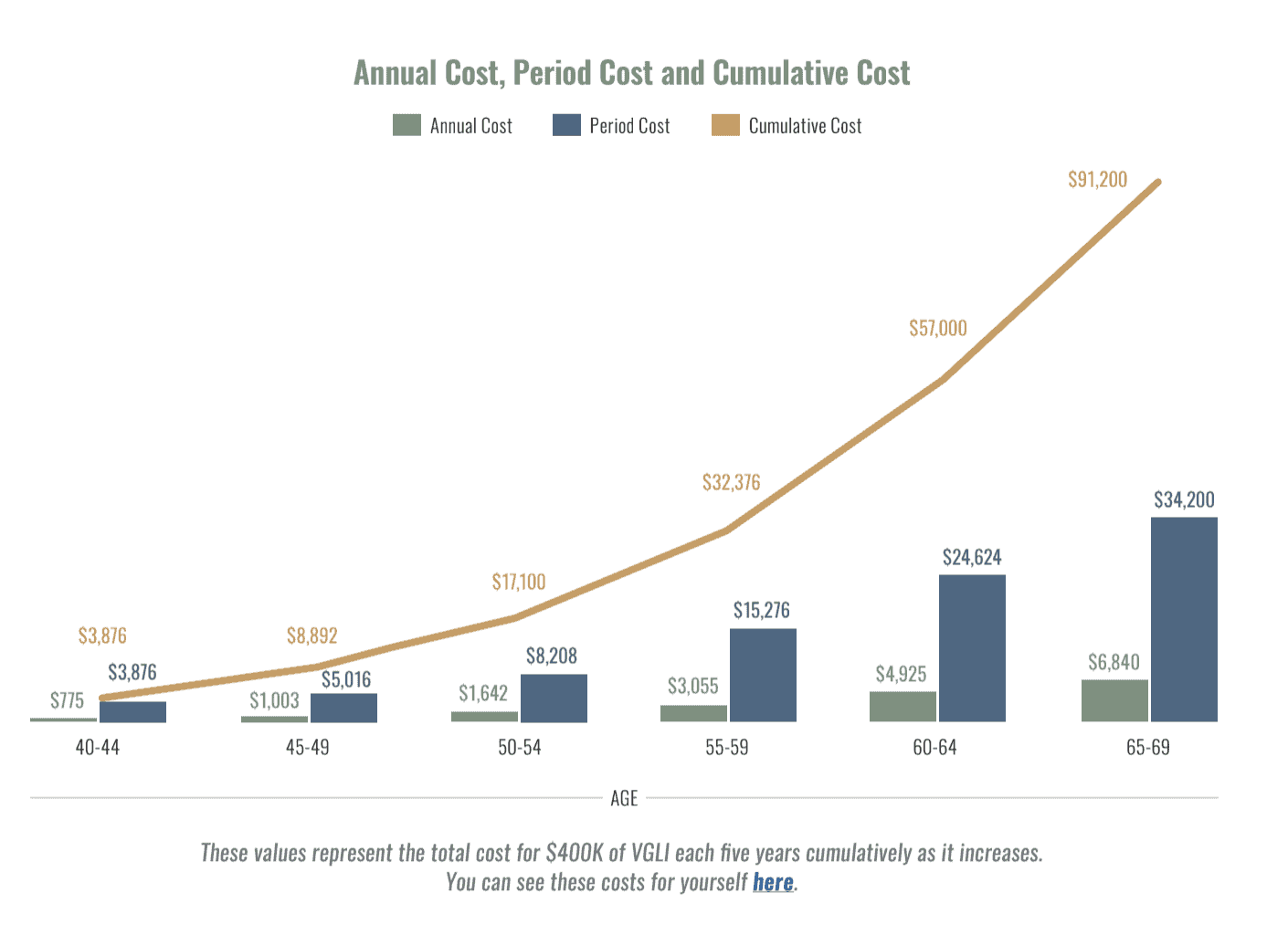
The premium rates for VGLI are based on your age and rise as you age.
For example:
- A 30-year-old veteran pays approximately $32 monthly for $400,000 in coverage.
- At age 60, the same coverage costs $432 per month.
- By age 75, premiums for $400,000 in coverage skyrocket to $1,840 monthly.
These escalating costs can strain retirement budgets, especially those living on a fixed income. While the guaranteed renewability ensures coverage, many veterans find it cost-prohibitive in their later years.
Benefits of VGLI
The main advantage of VGLI (Veterans’ Group Life Insurance) is the guaranteed acceptance within a 240-day window. This is particularly beneficial for veterans with pre-existing health conditions who may struggle to qualify for private life insurance. Furthermore, VGLI is portable, meaning you can keep your coverage if you change jobs or move to a different state.
However, it’s important to note that the value of VGLI can decrease over time because premiums tend to increase while the coverage amount stays the same.

Case Study: O5 Retiree Assessment
Consider the example of an O5 service member nearing retirement. With 20 years of service, their military pension represents a significant portion of their financial security, valued at over $2.5 million when projected over their lifetime.
Upon retirement, this O5 is offered two primary options for protecting their family’s financial future:
- Enroll in VGLI to maintain life insurance coverage.
- Opt into the Survivor Benefit Plan (SBP), which provides a lifetime annuity to a designated beneficiary upon the retiree’s death.
VGLI in Action
Our O5 retiree opts for $400,000 in VGLI coverage. While this provides a lump sum death benefit, the premiums increase significantly over time, consuming a growing share of their retirement income. Moreover, more than $400,000 may be needed to replace the income provided by their pension.

SBP in Action
If the retiree selects the SBP instead, their spouse receives 55% of the pension as a monthly benefit after the retiree’s death. While the SBP offers lifetime income security, it requires a monthly premium deducted from the retiree’s pension.
Alternatives to VGLI
For many veterans, exploring private life insurance or hybrid financial strategies offers a more cost-effective and flexible approach to securing their family’s future.
Private Life Insurance
Private policies typically offer more flexibility and affordability than VGLI, particularly for younger and healthier veterans.
Options include:
- Term Life Insurance: Lower premiums for a fixed coverage period, ideal for short-term needs.
- Permanent Life Insurance: Higher premiums but includes a cash value component that grows over time.
Unlike VGLI, private policies can be customized to match individual goals, such as covering mortgage debts or funding education expenses.
Hybrid Financial Solutions
Some veterans turn to financial products that combine life insurance with investment growth, such as indexed universal life (IUL) policies. These solutions allow policyholders to build cash value while maintaining a death benefit, offering a balance of protection and wealth accumulation.
Considerations for Private Life Insurance
When evaluating life insurance options, consider these critical factors:
- Military Pension Value: Determine how much of a lump sum death benefit is needed to protect your pension.
- Health and Age: Compare VGLI and private insurance costs based on your health and age.
- Flexibility: Opt for a solution that allows adjustments as your financial situation evolves.
- Cost-Effectiveness: Assess the long-term affordability of premiums.
- Legacy Goals: If wealth transfer or estate planning is prioritized, consider policies with cash value components.
Making an Informed Decision
VGLI is a valuable option for veterans seeking immediate, no-questions-asked life insurance coverage. However, its rising costs and static coverage make it less practical as a long-term solution. Exploring alternatives like private insurance or hybrid financial products may offer better results for those planning to protect their military pension and provide lasting financial security for their families.
Every retiree’s situation is unique, and there is no one-size-fits-all answer. Consulting with a financial expert who understands the intricacies of military benefits can help you confidently navigate these decisions.

Is VGLI the right fit for your retirement plan?
Schedule a free consultation with US VetWealth today. Our experts specialize in helping military families find competitive private life insurance so you have more flexibility with VGLI and SBP.
Calculators. Case Studies. The Full Strategy.
The SBP decision isn't a math problem you solve alone — it's a joint call with your spouse. The private alternative has to fit your pension size, your family structure, and your timeline. The SBP & VGLI strategy page walks through the full picture: what you'd give up, what the alternative looks like, and how the math holds up.

Scott R. Tucker
Scott is the founder of US VetWealth. West Point graduate, former Army officer. He’s spent 16+ years working specifically with career military leaders on the financial decisions the retirement brief never covers.
He built the War Chest Strategy as a private framework for military retirees — SBP alternatives, tax-advantaged retirement income, and legacy in one structure. A third asset class alongside the pension and any existing investment portfolio, designed for retirees who’d rather control these decisions than rely on government programs that weren’t built for them.
Scott is the author of Veteran Wealth Secrets and Don’t Forget Your War Chest. He co-hosts the Military Retirement Blueprint podcast with CAPT (Ret.) Mike Wallace.
Disclaimer: The views expressed by Scott R. Tucker are for educational purposes only and do not constitute financial, tax, or legal advice. Scott is a licensed insurance professional offering financial services and products. Always consult with a qualified advisor before making financial decisions.